Can an AC Be Too Powerful for Your Home?
Summary:
While many homeowners believe that a larger AC unit guarantees better cooling, an oversized air conditioner can create problems. It causes short cycling, humidity issues, higher energy bills, and increased wear and tear. There is no solution to an oversized AC, so consult an AC technician for assistance in choosing the right unit for your home.
Table of Contents
Introduction
Choosing the right-sized AC for your space is crucial. Many homeowners believe that bigger is better, but that is not always the case. During AC installation, your AC contractor will size your new system to ensure optimal performance. This process has nothing to do with the physical space that your unit occupies, but rather its cooling capacity.
It is essential for your AC to have the cooling capacity to meet your home’s cooling needs. It should be neither undersized nor oversized. It is easy to understand why an undersized AC is bad news, as your system will run constantly and still be unable to provide sufficient comfort for your home.
However, an oversized AC is just as bad. This article examines the risks associated with oversized air conditioners and guides on selecting the correct AC size for your home.
Dangers of Over-Sized Air Conditioners
An air conditioner that is too powerful can create more problems than it solves. Here is how:
1. Short Cycling
Air conditioning systems work on cooling cycles. When your thermostat signals that your space needs cooling, the fans and compressors activate the cooling cycle. An average cooling cycle lasts approximately 15 minutes, depending on the temperature in your house and your thermostat settings. When cooling is achieved, your thermostat signals the AC, and the compressor cycles down.
But an AC that is too powerful throws off the cycling. An oversized AC cools the air so quickly that the thermostat mistakenly thinks the entire house has reached the target temperature. Although the system has not been running long enough to distribute the cool air throughout the house, the cooling cycle cuts off before it can complete. It will take a few minutes for the temperature to rise again and for the thermostat to restart your air conditioner – this happens repeatedly. It is known as short cycling.
Short cycling puts an enormous stress on your AC components, particularly the compressor. It increases the wear and tear on your system and also increases energy consumption, contributing to a higher energy bill. It also affects comfort as cooling will be uneven – the center of the house will be too cold, while the outer parts will be too hot and uncomfortable.
Edit Content
"*" indicates required fields
2. Increased Humidity
One of the key roles of your air conditioner is to remove excess moisture from the air. If your AC is oversized, the system will not run enough to complete the full dehumidification cycle. While the temperature drops and the humidity remains high, you are left with a room that feels damp, sticky, and uncomfortable.
Apart from making your home sticky and uncomfortable, high humidity also encourages the growth of mold and mildew, which can damage your home and impact indoor air quality, leading to health complications.
If you notice uneven temperatures or hot spots in your home, contact your air conditioning contractor for assistance. While regular AC maintenance services can marginally increase the efficiency of your system, it is only a stopgap solution.
3. Higher Energy Bills
An oversized air conditioner might seem like the solution to maintaining the perfect temperature in your home. However, the rapid cooling comes with a hefty price. Oversized units turn on and off in short bursts. And each time that happens, the compressor draws a surge of electricity, increasing your energy consumption. This is in contrast to an appropriately sized system that runs longer and in smoother cycles.
Short cycling also increases the strain on your system components, particularly the compressor and blower unit, making them less efficient. When this happens, your system will struggle to keep up, consuming more energy to meet your cooling needs.
Additionally, because the system does not run long enough to remove excess moisture in the air and cool your home evenly, you find yourself manually adjusting the thermostat to achieve a comfortable indoor temperature.
4. Premature Wear and Tear
An oversized air conditioner will accumulate wear and tear simply by operating. Every time you turn on your system, it puts a strain on key components, including the blower motor, fan, and compressor. The strain wears down the components, making them perform inefficiently and eventually break down.
How To Choose the Right AC Size for Your Home?
Choosing the right AC size is crucial for optimal comfort, energy efficiency, and system longevity. Here are some tips from our AC contractor in Orange County.
1. Understanding Cooling Capacity
Air conditioners are typically sized by their BTUs (British Thermal Units), which measure the amount of heat needed to raise the temperature of one pound of water by one degree Fahrenheit. When it comes to cooling, BTU ratings indicate how effectively and efficiently a unit can cool your room without wasting energy or causing excess wear.
If your cooling capacity is too low, your unit will struggle to effectively heat your home, resulting in constant operation and higher energy bills. And if it is too high, it will lead to increased humidity, high energy bills, and premature wear and tear.
Understanding the cooling capacity of your unit and how to calculate BTU is the first step in picking the right AC size for your home.
2. Room Factors to Consider
Most contractors will tell you that calculating the BTU of your AC is not enough. Other factors can directly impact the amount of cooling power you will need. Some of those factors include:
- Room Dimensions: The size of the room that needs to be cooled is the most crucial factor to consider when selecting an air conditioner. Larger spaces require units with larger capacities, while smaller rooms require units with smaller capacities.
- Number and Size of Windows and Doors: The number of windows and doors in the room will influence the size of the AC you need. Insufficient or poorly sealed openings will allow warm air to enter while letting cool air escape. Additionally, rooms with larger windows will absorb more heat and therefore require a larger unit to maintain comfort.
- Insulation Quality: Well-insulated rooms will keep cool air inside, reducing the workload on your comfort systems. If your space is well-insulated, you may need a smaller AC unit; however, if it is poorly insulated, you should opt for a larger unit.
- Ceiling Height: Air conditioner BTUs are calculated using a standard 9-foot ceiling. If you have a higher ceiling, that means greater volume, which will affect your air conditioner’s efficiency. Therefore, a room with a ceiling height exceeding 9 feet will require an additional cooling capacity.
3. Heat Load and Occupancy
You should also consider the heat load of your space. The more people you have in a room, the more heat is generated. The typical BTU is calculated with two occupants in mind; each additional occupant raises the cooling demand. Therefore, larger units are often required in spaces where large crowds are anticipated.
Common household appliances, such as ovens, dryers, and computers, also generate heat. This increases the cooling capacity required by an air conditioner.
4. Types of AC
The best type of air conditioning (AC) unit you need for your home depends on the layout of your space. Instead of choosing the most significant or most expensive type available, it is better to have your AC contractor perform the calculations and provide a recommendation.
The most common air conditioning units are:
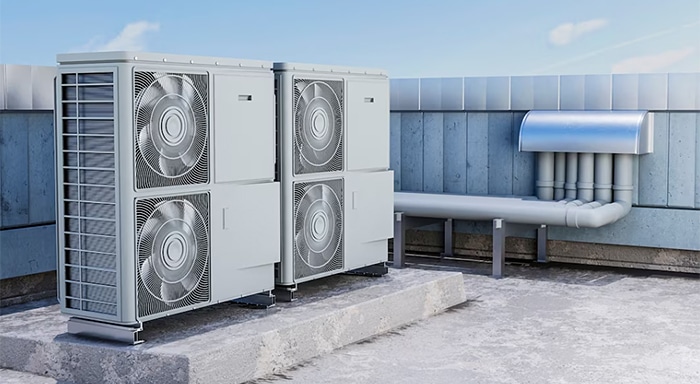
- Central Air Conditioning: Central air conditioning systems are larger, more complex units designed for whole-home operation. They operate with an extensive ductwork system to distribute cool air throughout your entire house.
- Ductless Mini-Splits: Split unit ACs are efficient at cooling. While they are more expensive than most models and require installation by an AC contractor, they compensate for this with high cooling performance.
- Window Units: These models are perfect for small spaces. They are typically installed by the window and are also very affordable.
- Portable Acs: Portable AC units are standalone cooling systems that can be easily plugged into a wall socket and provide instant cooling. You can easily move these units from room to room, and they are efficient in smaller spaces.
Contact Expert AC Contractor Now!
5. Calculating The Right Size and Capacity
To calculate the right size of AC for your home, it is recommended that you consult a professional AC technician. You can also use Manual J Load calculations, which is an HVAC industry standard that considers all room factors, including heat load and climate, for better sizing.
Conclusion
While you might be tempted to get a bigger air conditioner, an oversized AC will do more harm than good to your home. Always check with an AC contractor before making the final decision. The dangers of getting a bigger air conditioning unit include short cycling, increased humidity, higher energy bills, and premature system breakdown.
It’s essential to note that there is no solution to an oversized AC; even AC maintenance services cannot resolve it. And this is why you must get it right the first time. Consult with our AC contractor in Orange County for more information on choosing the right cooling system for your home.
FAQs
1. What happens if the air conditioner is too large for a house?
Air conditioners that are too big consume more energy, endure more wear and tear, and have a reduced lifespan compared to an appropriately sized system.
2. Can an air conditioner be too powerful?
Yes, an air conditioner can be too powerful for your building. When this happens, the system will short cycle, meaning it turns on and off before completing a full cooling cycle.
3. Is it better to undersize or oversize your AC?
None is better. Undersized and oversized systems will provide inefficient cooling, accumulate wear and tear, and eventually break down due to the strain on their components.
4. Is it bad to oversize a window air conditioner?
An oversized AC will cool your room faster, but it can also waste a lot of energy and leave the air feeling cold, damp, and clammy.
5. How to Determine if an AC Unit Is Too Big?
If your AC runs for only a few minutes and spends most of its time turned off, then it is likely oversized.
6. What happens if AC is overloaded?
When your AC becomes overloaded, its coils become too hot, causing the pressure to rise throughout the entire device. When the pressure reaches a certain point, your system will shut down until it cools off.
7. Will a bigger AC make my house colder?
While a larger AC unit may not cool the house faster, it could cause some serious problems, including short-cycling, higher energy bills, premature wear, and system breakdown.
As a general rule, your AC will be able to cool to about 15-25 degrees below the outside temperature. So, when it’s 95 degrees outside, expect your system to cool to approximately 70-80 degrees.
9. Why choose Klondike Air Contractors?
When a HVAC system is clean, it doesn’t have to work as hard to maintain the desired temperature.
To determine AC capacity, use the general rule: 1 ton for rooms up to 120 sq. ft., 1.5 tons for 121-180 sq. ft., and 2 tons for 181-240 sq. ft.